Last week I wrote about the glorious problem that is price sensitivity at retail.
It seems that a lot of CPG brands transitioning into larger retailers come up against this somewhat ironic issue pretty regularly.
Ironic because they were selling fine at farmers markets, boutique stores & DTC for $15, but when retailers make them drop their prices to $10 there’s suddenly price sensitivity from customers.
I highly recommend going back to read last week’s blog thing if you haven’t already. This is turning into a labour of love and it’s going to be a 6-12 parter (depends when I lose steam honestly).
So this is part 2.
Today I wanna focus on the first thing you should think about when attempting to combat price sensitivity – Positioning.
Positioning: Creating the highest perceived value
Positioning means a lot of different things to a lot of different people, but to me the goal of positioning is to create the highest perceived value for your product or service.
The word perceived is a little bit misleading here, it seems like I’m saying “fake value”, but perceived value is value. It’s why I’m happy to spend money on a nice dinner, where someone else might prefer to spend theirs on nice clothes. We perceive value differently because it’s personal.
Creating the highest perceived value in your thing goes a little bit deeper than a product or services surface level utility. Your cake isn’t worth $10 as a solution to hunger. Your beverage isn’t worth $6 as a solution to thirst.
A nice dinner is not really the source of the value for me. The source is experience, service, exploration of new flavour combinations, atmosphere, inspiration & creating memories with friends & family. That’s how I sell it to myself. Even if it’s not the cheapest option, I can justify it because it ticks a lot of important boxes for me personally. Both in how I develop as home cook, experiences that build my character, and amazing memories to make life feel more lived.
The same way someone who loves clothing might be interested in the story associated to that specific brand, or the level of detail in their garment selection & build. It says something about who they want to be, the care they take in the details of their life. It builds you into someone better than you were before. Now you can justify paying double for that jacket. Now it’s personal.
This is called a psychographic, it’s the true “why” your customers feel when they buy from you. A connection that outweighs the transaction. Your demographic is only half of the picture.
Super Fans vs Fringe Buyers (Negative Binomial Distribution)
The next thing that’s really worth considering, is that your super fans do not need convincing. They’re buying multiple times a week, they get it. They’re very unlikely to buy more or less because of a change in positioning, branding or advertising. Counterintuitively, we need to understand your mid level & casual buyers, the people who buy 2 or 3 times a year.
Habel and Goodman (2008) describe this insight in their research on consumer behaviour modelling. Their work explains how a customers purchase frequency primarily follows what’s called a Negative Binomial Distribution (NBD), where the majority of a brands consumers are occasional buyers, while a smaller segment represents heavy users. Their research suggests that understanding these mid-level buyers is crucial, as they typically represent a substantial portion of your market that isn’t fully committed to your brand. Unlike your super fans, these buyers’ decisions are more influenced by your positioning and perceived value propositions – making them the ideal target for strategic marketing efforts. This pattern is also widely documented and discussed in the book ‘How Brands Grow’ by Byron Sharp (Updated 2019).
They discuss that NBD, broadly speaking, demonstrates:
- Your top 20% of customers (as ranked by purchase frequency) are responsible for 50% of sales.
- Your next 30% of customers are responsible for 30%-35% of sales.
- Your bottom 50% of customers are responsible for 15%-20% of sales.
That’s 45%-50% of sales that are directly influenced by positioning, marketing, branding. Whilst the other 50% already love you and don’t need convincing. That’s not to say that we ignore the super fans, it’s just that they already understand what makes your product or brand amazing and it’s likely any update to positioning, brand strategy or packaging won’t dramatically increase or decrease their purchase frequency.
Example: Repositioning Churn Foods
It’s getting wordy and conceptual so let’s ground it in an example.
When we first rebranded and repositioned the flavoured butter brand, Churn, we wrongly aimed at their diehard fans. The positioning and copy spoke to dinner parties, to being your secret weapon in the kitchen. This was a representation of their heaviest users. People who loved to nerd out in the kitchen prepping and cooking extensive meals for friends and family. Whilst it was an upgrade to their previous positioning, the new insights given to us by understanding NBD say that it wasn’t going to move the needle enough.
If the bottom 50% of customers are the ones who really need convincing, we need to think about their wants, needs, hopes & dreams. NOT the home cook who absolutely wants long-ass recipes to spend 4 hours on a Sunday tinkering with.
So what would encourage a casual user to buy flavoured butter 2 or 3 times a year? Convenience, value for money and flavour exploration.
Let’s say you have family of 4. You and your husband both work late and you realise there’s nothing in the fridge other than a few pieces of chicken and some veggies. The last thing you want is to see some 15 step recipe for a “dinner party dazzler” that includes $10 worth of butter. In a long recipe, $10 is way too much for just 1 ingredient.
But what if it was the only ingredient you were missing?
You have chicken. You have veggies. What you don’t have is anything that turns them into a delicious meal for 4 with 0 effort, thinking or prep. Unless you grab a tub of Churn on the way home. Yes it’s $10, but if it means I can save 40 minutes of prep & 15 minutes of clear up 6 or 7 times over the course of the next month, whilst putting a delicious meal on the table for my family, AND I don’t need to think about “how”, suddenly $10 looks real nice. I’d pay $10 to save 7 hours all day, especially if that $10 made my dinner taste like a chef made it.
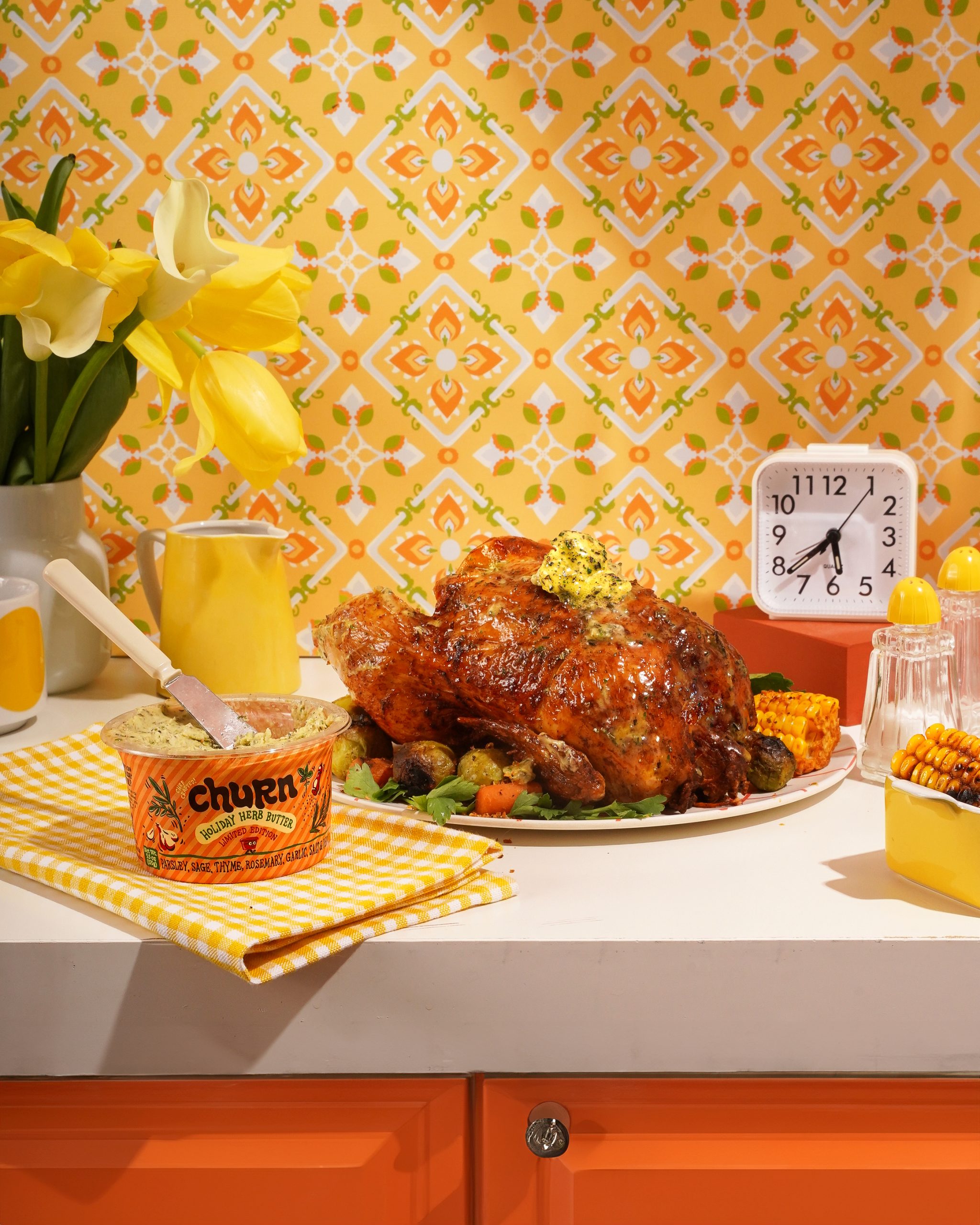
To reiterate, this isn’t how their primary buyers think. This is how their casual and less engaged buyers think. This is how we speak to their perception of value. This is how a $10 ingredient in a time consuming recipe can be repositioned to be a no brainer. Think of it like you would a jar of pre-made pasta sauce, but with far more servings per tub.
So we adjusted the positioning and messaging. We made the packaging far more clear with very direct use case copy. “Melt, Spread or Cook, Churn IS the recipe”. We worked with their email & ad team to build even more direct messaging. Short snappy ads that focused on the convenience & flavour.
“Steak, Churn, Done”, “Chicken, Churn, Done”. Emails that showed long shopping lists for creating your own pesto butter side by side with very short Churn-based ones. These quickly demonstrated how not only were you saving time, but a lot of money too.
It worked a treat. They’re now rolled out nationwide at Target – a place where undoubtedly their less engaged buyers shop.
Again, this is absolutely not to say that we now ignore the diehard fans, but the people that get it get it. If your product is complex, needs explanation or requires imagination, we have to build that for the people who need it. The people who don’t need it aren’t engaging with that content. They know how to use your thing, they know the value it brings them. Of course we have to consider them when building the brand, they’re your ride-or-dies, but all we’re doing is explaining different aspects of value to different people.
Actionable Steps
So the actionable steps part.
- List out the top 5 things you love about your brand. Be brutally honest about it or it’s not worth your time. If the real answer is “It makes me feel cool” that is incredibly valuable insight, and likely your customers feel that too.
- List out the 5 most common pieces of positive feedback in your product reviews
- List out the 5 most common negative pieces of feedback in your product reviews
You now have a starting point for a few things. The first two bullet points are a broad overview of what makes your brand special, what you and your superfans love about your brand. It’s likely there’s some crossover between those first 2 lists. These are the things we need to communicate to your less enthusiastic fans.
The 3rd point is a broad overview of things that are either miscommunicated or unclear about your brand. Let’s say you sell a better for you chocolate flavoured energy bar and the most common piece of negative feedback is “The texture of this chocolate bar sucks, me and my boys all agree”. That’s a communication problem. Expectation didn’t live up to reality.
If your customer thought it was a chocolate bar, then you did something wrong on pack, you positioned it as something it wasn’t. Now Jerry from Missouri holding the fish in his profile pic is pissed. The perceived value was much lower because of the gap between expectation & reality. The best BFY energy bar in the world isn’t going to beat Cadbury’s/Hershey’s in a chocolate fight.
IF however, you were properly positioned as an indulgent BFY energy bar that ACTUALLY tasted like chocolate. All the taste, 0 waist(line). Made from exclusively XYZ. Built for energy & taste. Well now Jerry understands that this thing isn’t gonna snap like a Hersheys bar, it’s gonna smush like an energy bar. If he’s still in the market for that type of product then this thing is killer. It’s the best tasting energy bar he’s had.
5 stars from Jerry in Missouri.